
The Short Answer
1940s Hamilton wristwatches are American-made, manual-wind watches built in Lancaster, Pennsylvania, in two very different chapters. Before and after World War II, Hamilton made gold-filled and solid-gold dress watches. From 1942 to 1945 it stopped making consumer watches altogether and produced more than one million military timepieces, including wristwatches and marine chronometers. Collectors prize both: the dressy civilian pieces for their Art Deco and “top hat” styling, and the wartime issue for its history.
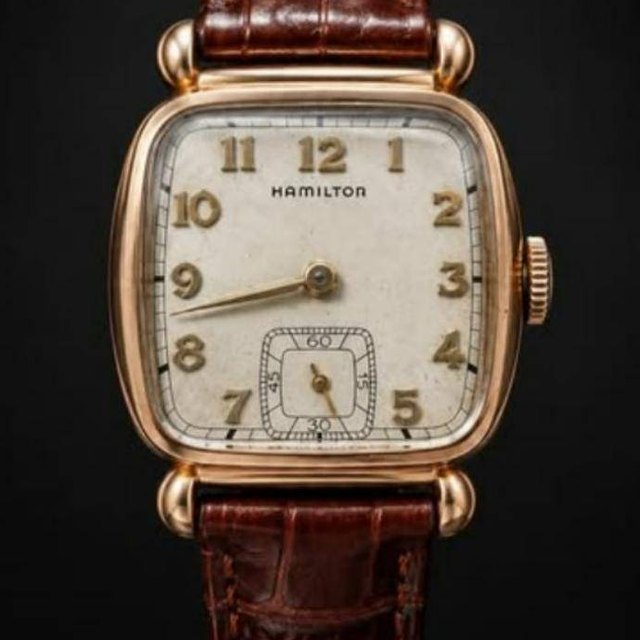
Hamilton 1940s at a glance
| Maker | Hamilton Watch Company, Lancaster, Pennsylvania (founded 1892) |
|---|---|
| Era | 1940–1949 |
| Movement type | Manual-wind mechanical. Calibers you will meet include the 17-jewel 980 and the 987. |
| Typical cases | Gold-filled (such as 14K gold filled) and solid 14K gold in yellow, white, or rose; utilitarian cases on military issue |
| Wartime output | More than one million timepieces between 1942 and 1945, including wristwatches and marine chronometers |
| Model names you will see | Boulton and Gilman, plus “top hat”, curved Art Deco, and cocktail-watch styles |
Before the war: from pocket watches to wristwatches
Hamilton was founded in 1892 in Lancaster, Pennsylvania, and built its reputation on accurate pocket watches, the kind trusted by railroad men. The company’s own history marks 1917 as the turning point toward the wrist: Hamilton equipped hundreds of soldiers with timepieces, and the wristwatch proved it was here to stay.
By the 1940s the wristwatch had fully replaced the pocket watch for everyday wear, and Hamilton was competing in a market that prized slim, elegant dress watches. That is the world the early-1940s Hamiltons were born into: rectangular and curved cases, applied numerals, and warm gold finishes.
The war years, 1942–1945
In 1942 Hamilton stopped producing watches for consumers and turned its factory over to the U.S. Armed Forces. According to the company, it produced more than one million timepieces between 1942 and 1945, including wristwatches and marine chronometers, and earned an Army-Navy “E” Award for manufacturing excellence.
Some of what came off the line during these years:
- Marine chronometer Model 21. Used aboard battleships and aircraft carriers, it kept time to within half a second per day, comfortably inside the Navy’s requirement of 1.55 seconds.
- Military wristwatches. These included a U.S. Navy wristwatch and a Khaki Field watch built around the grade 649 movement.
- Water-resistant “Canteen” watch. Supplied to U.S. Naval divers during the war.
- A Time Comparator. Hamilton also built the machine used to test Navy chronometers, able to detect dial error to within 1/100th of a second per day.
For collectors this creates a clear dividing line. A Hamilton made between 1942 and 1945 is almost certainly military issue; a civilian dress watch is either from 1940–1942 or from the postwar years.
After the war
With the war over, Hamilton returned to civilian production, and the dress watch took center stage again. The Boulton, a name you will still see on vintage listings today, was first introduced in the 1940s. The decade’s other notable design languages, from curved Art Deco cases to the distinctive “top hat” shape, carried Hamilton into the 1950s, and in 1957 the company shook up the industry again with its battery-powered Hamilton Electric.
Styles and cases to know
Because Hamilton produced such a wide range, it helps to recognize the main families:
- Art Deco tank and curved cases. Rectangular watches whose cases curve to fit the wrist, usually in yellow gold-filled.
- “Top hat” cases. A stepped, tiered profile found in both gold-filled and solid 14K gold, sometimes diamond-set.
- Cushion and square cases. Softer, rounded-corner shapes with applied gold numerals, like the watch pictured above.
- Cocktail and ladies’ watches. Small, jewelry-style pieces in 14K white, yellow, or rose gold, sometimes set with diamonds or rubies.
- Military issue. Plain, legible dials and hard-wearing cases, such as the Khaki Field and Navy models described above.
Gold-filled cases dominate the mid-priced end of the market, while solid gold and gem-set pieces are scarcer. If you want to understand the parts behind these watches, our guide to what’s inside a watch walks through a movement piece by piece, and our watch houses page puts Hamilton’s story in context with the great makers of Europe.
Movements
Every 1940s Hamilton wristwatch is a manual-wind mechanical watch: you wind the crown daily and the mainspring does the rest. The 17-jewel caliber 980 turns up in many dress models, including top-hat watches, and the caliber 987 appears in watches dated to the early 1940s. A signed Hamilton movement, with a clean, original bridge and balance and a serial number you can look up, is the first thing we check on any watch we buy.
How to buy one: a collector’s checklist
- The dial. Original dials show fine, crisp printing and honest aging. Heavy retouching or a reprinted dial reduces both appeal and value.
- The case. On gold-filled cases, look at the lugs, the bezel edge, and the caseback for brassy wear-through. Over-polishing softens sharp edges and erodes engraving.
- The movement. Confirm it is signed Hamilton and appropriate to the case and era, and ask for the serial number so you can date it.
- Service history. A vintage mechanical watch should run well on the wrist, not just on the timing machine. Ask when it was last serviced and by whom.
- Hands and crystal. Mismatched hands are a common substitution. A crystal that fits the case properly is usually a good sign.
- Luminous material. Dials and hands from this era commonly used radium-based luminous paint. If it is intact, it is sealed under the crystal and presents little concern, but it is a good reason to leave the case closed unless a watchmaker is doing the work.
- The seller. Buy from someone who will tell you plainly what has been serviced, what is original, and what is not.
Wearing and caring for a 1940s Hamilton
These watches were made to be worn, but they predate modern water resistance, so treat them as dress watches: keep them away from water, wind them gently at a regular time each day, and avoid pushing hard on the crown. Most watchmakers recommend servicing a vintage mechanical watch every few years to keep the oils fresh and the movement protected.
Frequently asked questions
Did Hamilton make watches for civilians during World War II?
Not after 1942. Hamilton stopped producing watches for consumers in 1942 so it could concentrate on supplying the U.S. Armed Forces, and between 1942 and 1945 it built more than one million timepieces, including wristwatches and marine chronometers. Civilian dress watches from the decade therefore date from roughly 1940–1942 or from after the war.
Are vintage Hamilton watches from the 1940s mechanical or quartz?
They are mechanical. 1940s Hamilton wristwatches use manual-wind (hand-wound) movements, which means you wind the crown each day. Quartz did not exist yet, and Hamilton's first battery-powered watch, the Hamilton Electric, did not arrive until 1957.
What is the difference between gold-filled and solid gold cases on 1940s Hamilton watches?
A gold-filled case has a thick layer of gold bonded over a base metal and is marked with a karat and a 'gold filled' stamp (for example 14K gold filled). A solid gold case is gold throughout and is typically stamped with the karat alone. Gold-filled cases can wear through to the base metal at the lugs and bezel edges over decades, while solid gold cannot.
How can I find out the year my Hamilton was made?
Look for the serial number on the movement (and often on the caseback), then compare it with Hamilton's published serial number tables. Case styles, dial design, and any military markings help confirm the era. If you would like a second opinion, send us photos through our contact page and we will take a look.
Is a vintage Hamilton from the 1940s a good first vintage watch?
Many collectors think so. They are American-made, they were built to be serviced, and parts and watchmaker familiarity are easy to find. The key is condition: look for a clean original dial, a movement that has been recently serviced, and a case that has not been over-polished.
Looking for a vintage Hamilton?
We hand-select every watch we sell. Browse what’s on the bench right now, or tell us what you’re hunting for and we will keep an eye out.
Have a Hamilton to sell? Get a quote.
- Hamilton Watch — company history timeline (founding, 1917 wristwatch shift, 1942 shift to military production, Model 21 chronometer, Time Comparator, Army-Navy “E” Award, Boulton)